Tacit Knowledge
A Graduating Senior's Field Notes on the Future
Within 6 months, three of the hardest problems humans have ever posed fell to AI.
Three days ago, a 250,000 page (17 million lines!) proof of the Generalized Riemann Hypothesis was released by Anthropic. The hypothesis that stood unproven for 167 years has been widely regarded as the absolute crown jewel of pure math. This came only 2 months after the release of a finite-time blow-up proof to the Navier-Stokes existence and smoothness problem and 6 months after the Erdős unit distance conjecture was disproved, both by OpenAI.
It is increasingly harder for humans to understand these AI results. It is unlikely anyone will be able to fully digest 250,000 pages of the GRH proof. It was similarly said to be very difficult to extract any human understanding from the Navier-Stokes proof when it came out. What AI has brought us is the productive output. Throw enough compute at any problem and it seems like we will have all the answers, but not yet the understanding.
What a terrifying time to be graduating from college [1]. It has never been clearer that the world we grew up in no longer exists [2]. What else is there left for humans, or in a more specific and personal context, a graduating college senior to do?
Tacit Knowledge & Explicit Knowledge
In 1958, Philosopher Michael Polanyi came up with the idea of Tacit Knowledge [3]. There are two types of knowledge in this world:
- Tacit knowledge: Skills, ideas, experiences that people possess but are not codified and may not necessarily be easily expressed. An intuition, something you hold, rather than something you look up. We can know more than we can tell.
- Explicit knowledge: Knowledge that is readily articulated, conceptualized, stored and accessed. Most forms of explicit knowledge are stored in some kind of medium like books, computers, on websites and in essays.
If AI has commoditized explicit knowledge, then the value of human work will shift toward the tacit. For someone entering the workforce, that points to four ways to stay relevant.
1. Having tacit knowledge
In the past, careers and progression were made primarily by becoming experts in certain fields. You start from an entry position and slowly climb up the corporate ladder as your understanding of the domain and business deepen. While AI makes it seem like expertise is now cheap, deep expertise is still relevant, only losing value as productive input while gaining value as judgement. Human experts will still be relied on to verify output, define standards and tests, and push the frontier. Signing your name is now the job. What is at risk is middle and entry level experts whose expertise only covers executing tasks.
How will a middle/entry level expert deepen their expertise? Here are some thoughts:
- Practice using simulations
Pilots never learned to handle engine failures by actually encountering one. They simply go through realistic simulations. In chess, the advent of AI engines capable of calculating hundreds of moves ahead only made young players play better and faster as they got unlimited, instant feedback on their play. AI generates cases, critiques and acts as your sparring partner and lets you attempt, fail safely, and learn thousands of times. - Supervision as reps
Simulation practice only works if you take it seriously. Review AI output by predicting the answers, compare with the output and argue with the output. Over reliance on autopilot causes "skill fade", where pilots forget how to fly. It is important to never fall into cognitive surrender and blindly approve all AI outputs. - Focus on developing tacit knowledge and intuition in things like creativity, taste, imagination, social skills, flexibility, courage, and perseverance.
2. Translating and building on tacit knowledge
Aim to sit between the people who have tacit knowledge and users who don't, and translate and build tacit knowledge into explicit knowledge. Turn something only human experts knew how to do into products machines and humans can use.
This is a way to think about the idea of Forward Deployed Engineers (FDEs): technical and product-oriented software engineers who are sent and embedded with clients to understand their business and products, so they can develop and deploy products directly into production systems and workflows. Understanding how to translate tacit knowledge into products like data sets, custom models, UIUX, distribution, pricing will probably become even more valuable and relevant.
3. Turning machine output into tacit knowledge
Machines can now produce explicit knowledge without requiring human tacit knowledge. We used to know more than we could tell. In the future, machines will tell more than we can know. A possible career direction in that future may be some kind of understander, where the main job is to consume machine output, mine for ideas and ingest the insights within them, turning machine output into tacit knowledge humans can carry.
In a way interpretability research is an understander job. LLMs know things they cannot explain. Their knowledge is spread across billions of weights that cannot be explicitly understood easily. Applying Polanyi's idea, models know more than they can tell. So interpretability research is literally an effort to externalize machine tacit knowledge.
So, two kinds of understander jobs: making sense of the output, and making sense of the machine. The way forward is to study someone (something) smarter than us.
4. Operating with tacit and explicit knowledge
Learning to operate and navigate between tacit and explicit knowledge will probably be extremely useful in working with AI. The SECI model of relationships between the knowledges offers a possible and interesting understanding of the relationships [4].
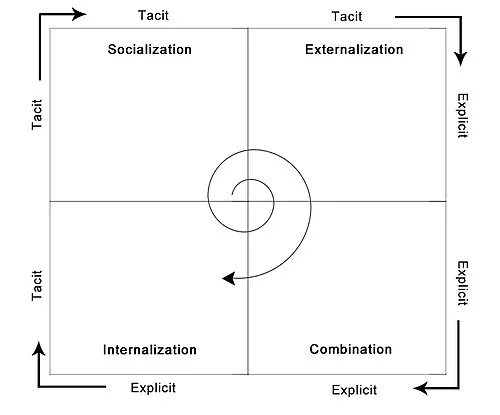
Using this framework, it is clear that Combination (Explicit -> Explicit) work like synthesis, search, summarization and review will be mostly done by AI, leaving the other three for us:
Externalization (Tacit -> Explicit)
- Writing prompts & Context engineering: Someone's intuition of how a task should be described and broken down written out in natural language
- Setting up feedback, evals, and rubrics
Internalization (Explicit -> Tacit)
- Understander jobs. Machine externalization feeds into human internalization
- Simulation practices & supervision as reps
Socialization (Tacit -> Tacit)
-
Probably the only thing that is still mostly unchanged for us to do, apprenticeship, socializing and interacting with other people.
-
One of the only ways tacit knowledge can still be passed on. In 2000, the process to create Fogbank, a secret material used in nuclear warheads, was nearly lost when the experts who knew how to make them retired. Five years and $92 million went into reverse engineering it [5].
When AI takes all the junior work, apprenticeship and shadowing will be the only way we can pass on tacit knowledge from seniors to juniors.
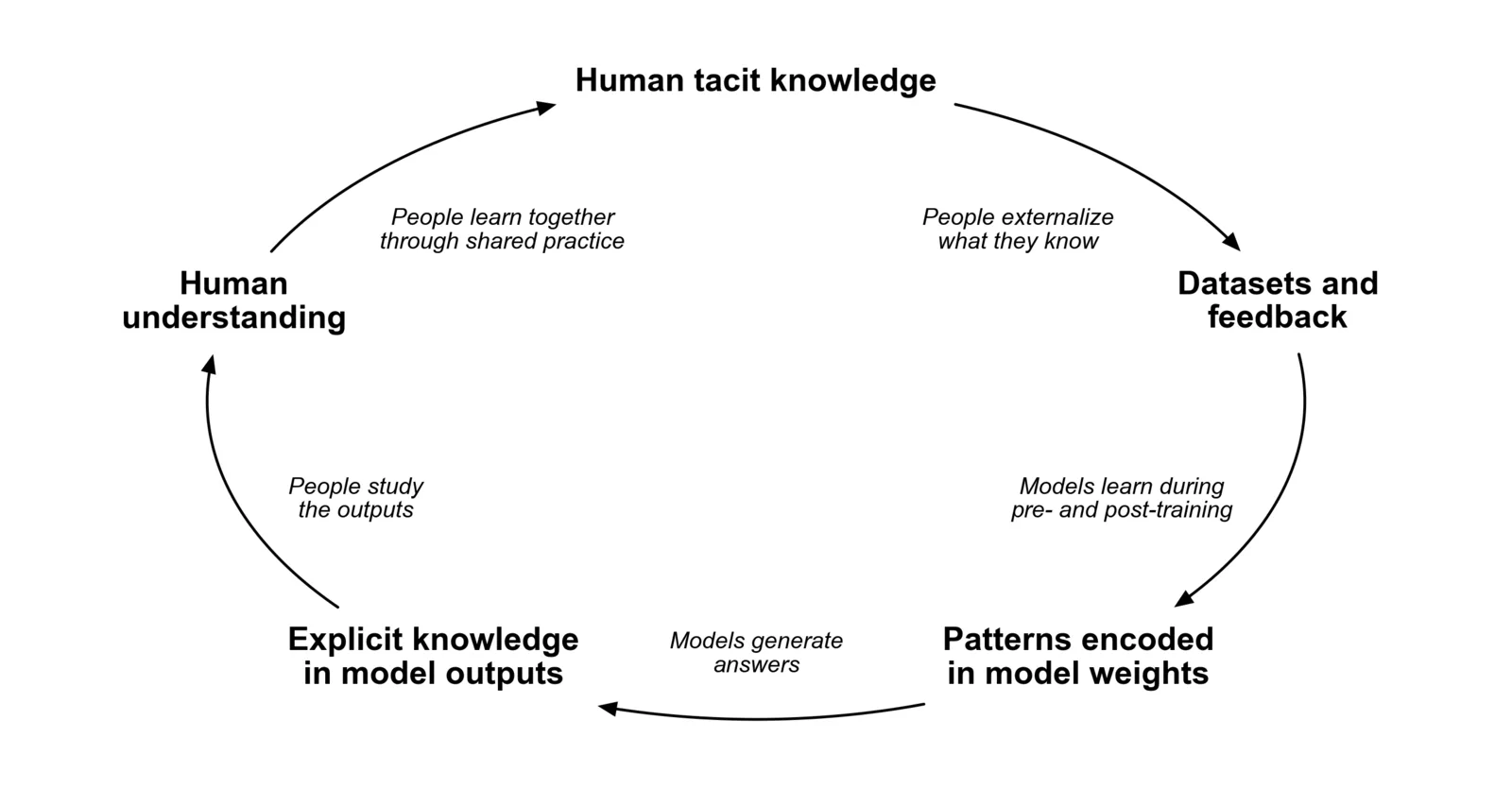
Fitting the four quadrants to machines, similar ideas show up. Training is internalization, turning written data into weights. Distillation or RSI is socialization, where older models teach newer ones. And model outputs and interpretability are externalization.
Putting it together, the ideas laid out above turn into one loop. Humans externalize what we know into data sets and feedback. Machines internalize it through pre- and post-training, then output explicit knowledge. Humans then study and internalize it as understanding, and through socialization generate more tacit knowledge to put back into the loop.
It is indeed a terrifying time to be graduating. The world we experienced and remember is fading fast, and change is the only way forward. Luckily, the job of exploring, creativity, understanding, socializing and navigating the relationship between human/machine knowledge is still ours to do. The most human job left, and the most interesting one to do!
Notes
[1] Jasmine Sun, 🌻 the old world is dying
[2] Antonio Gramsci, Prison Notebooks.
The old is dying and the new cannot be born: in this interregnum, morbid phenomena of the most varied kind come to pass.
[3] Polanyi used Tacit Knowledge to show the difference between humans and animals. Polanyi describes that many animals are creative, some even have mental representations, but can only possess tacit knowledge. Humans, however, developed the capability of articulation and therefore can transmit and develop tacit knowledge (via socialization, observation, imitation, practice through apprenticeship), and explicit knowledge (via teaching, writing, reading).
[4] Wikipedia, SECI model of knowledge dimensions.
[5] Center for Arms Control and Non-Proliferation, "Following the initial decision to close the Fogbank production facility NNSA lost many of the experienced personnel who had built the initial capability due to retirements, which further complicated the task of recreating a new capability from scratch... NNSA did not lose the knowledge of how to manufacture the material, but the retirement or departure of the staff experienced in building the original Fogbank production capability did complicate the task of building a new production capability."